Garage door track problems cause binding, grinding, and dangerous jams that prevent your door from operating safely. Identifying garage door track issues early prevents rollers from jumping the track and your door from falling out of position. A bent garage door track forces rollers to grind against the track walls creating noise, resistance, and accelerated wear on every component. Furthermore, a damaged garage door track can cause the door to derail completely leaving it stuck in an open or partially closed position. Garage door track alignment ensures rollers travel smoothly through the vertical and curved sections without resistance. In addition, knowing how to align garage door tracks restores smooth operation when minor shifts have occurred from vibration or impact. Garage door track repair addresses bends, gaps, and misalignment that prevent the door from functioning correctly.
Likewise, knowing how to fix a garage door track like a bent garage door track helps you understand what the repair involves and when professional service is necessary. If your door binds, scrapes, or moves unevenly, search for garage door track problems near you to get a professional evaluation.
How Garage Door Tracks Work
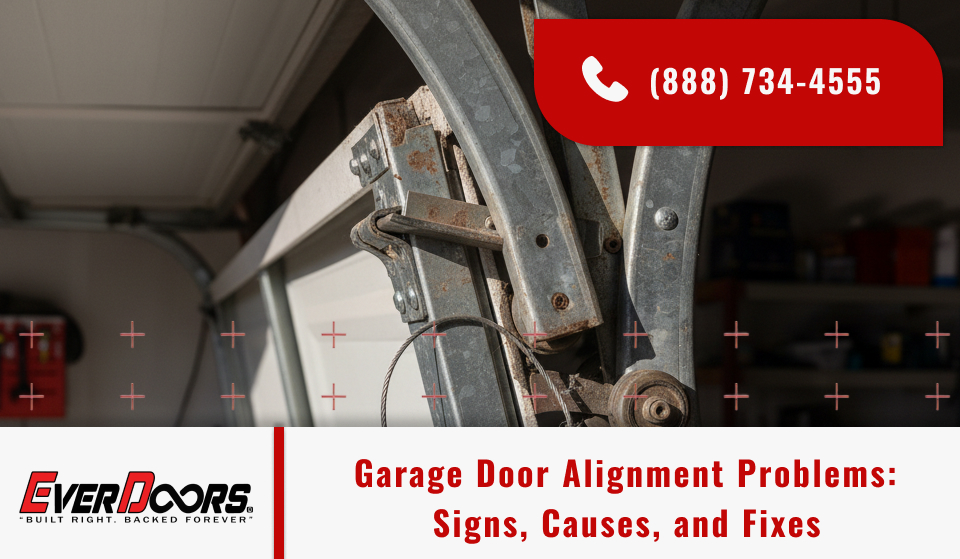
Garage door tracks guide the rollers and control the door’s path from the vertical opening to the horizontal position along the ceiling. Specifically, understanding how tracks function helps you recognize when garage door track problems are developing like a bent garage door track.
Here is how the track system operates:
- Vertical tracks on each side of the door opening guide the door during the first several feet of travel
- Curved sections transition the door from vertical to horizontal movement
- Horizontal tracks along the ceiling support the door in the open position
- Rollers attached to each panel ride inside the track channel throughout the travel path
- Track brackets bolt to the door frame and ceiling to hold everything in position
- The gap between the roller and track wall must remain consistent for smooth operation
Because every roller must pass through the curved section under the full weight of the door, any track imperfection at this critical transition causes binding. Therefore, the curved section is the most common location for garage door track issues.
Signs of Garage Door Track Problems
Garage door track issues produce specific symptoms that help you identify the problem quickly. Furthermore, catching these signs early prevents the door from jumping the track completely.
Here are the most common signs of garage door track problems:
- Grinding or scraping sounds as the door passes through specific sections of travel
- Also, the door hesitates or sticks at the same point during every cycle
- Furthermore, visible gaps between the rollers and the track wall
- The door moves unevenly with one side traveling faster than the other
- Additionally, the door shakes or vibrates excessively during operation
- Rollers have jumped out of the track partially or completely
- Metal shavings or dust on the floor below the tracks from grinding contact
- Finally, the door does not close flush against the floor on one or both sides
A bent garage door track often produces a consistent problem at the same point during every cycle. Consequently, if the door binds at the same spot every time, the track is likely bent or misaligned at that location.
What Causes Garage Door Track Problems
Several factors cause garage door track issues to develop. Specifically, understanding these causes helps you prevent track damage.
Impact damage Bumping the track with a vehicle, ladder, or heavy object bends the metal and narrows the channel. Furthermore, a damaged garage door track from impact is the most common cause of sudden track failure. In addition, even a minor bump can create enough of a bend to catch rollers during every cycle.
Loose mounting brackets Track brackets loosen over time from the vibration of daily door operation. Consequently, loose brackets allow the track to shift out of alignment creating gaps and misalignment. Furthermore, a single loose bracket can affect the entire track run on that side.
Worn rollers Rollers with flat spots, wobble, or broken bearings grind against the track walls and cause wear grooves. As a result, the track channel widens at worn spots and creates inconsistent roller movement. In addition, worn rollers accelerate track wear creating a cycle of damage.
Foundation settling Home settling shifts the door frame and the tracks mounted to it. Furthermore, settling causes one side of the door to move lower than the other which changes the track alignment gradually. Moreover, foundation movement is a common cause of garage door track alignment problems on older homes.
Temperature expansion Metal tracks expand and contract with temperature changes which can shift bracket positions over time. Consequently, tracks in uninsulated garages with extreme temperature swings experience more alignment drift than climate-controlled spaces.
Garage Door Track Alignment
Garage door track alignment restores proper roller travel and eliminates binding. Furthermore, knowing how to align garage door tracks helps you understand when minor adjustment versus track replacement is needed.
How to check alignment:
- Close the door and visually inspect the gap between each roller and the track wall
- Also, use a level against the vertical tracks to check for plumb
- Furthermore, measure the distance between the two vertical tracks at the top and bottom to verify they are parallel
- Check that both horizontal tracks maintain the same slight downward slope toward the back of the garage
What professional alignment involves:
- Loosening the bracket bolts that hold the track to the frame and ceiling
- Also, repositioning the track until the rollers travel through the channel without contact
- Furthermore, verifying the track is plumb on the vertical sections and properly angled on the horizontal sections
- Tightening all brackets to lock the track in the corrected position
- Finally, testing the door through multiple complete cycles to confirm smooth travel
Garage door track alignment costs between 75 and 200 dollars for professional service. Consequently, alignment is one of the most affordable repairs that restores smooth quiet operation.
Garage Door Track Repair Options
Garage door track repair depends on the type and severity of the damage. Furthermore, knowing how to fix a garage door track helps you evaluate repair options.
Minor bend straightening Small bends in the track can sometimes be straightened using a rubber mallet and a block of wood. However, this must be done carefully to avoid creating new damage. Furthermore, straightening works best for minor bends that do not involve creased or kinked metal.
Track section replacement When a section of track is severely bent, kinked, or worn through, replacing that section provides a permanent fix. Furthermore, replacement track must match the original in size, gauge, and radius. In addition, the curved section is the most commonly replaced component.
Full track replacement When tracks are badly damaged on both sides or have multiple problem areas, replacing the entire track set delivers the best result. Furthermore, full replacement costs between 200 and 500 dollars including parts and labor for both sides.
Track lubrication Sometimes track problems stem from debris and dry friction rather than physical damage. Consequently, cleaning the tracks with a damp cloth and ensuring rollers are lubricated resolves some binding issues without structural repair.
When to Call a Professional
Some track problems require professional tools and expertise to repair safely. Therefore, contact a technician for garage door track problems near you if any of the following apply:
- A roller has jumped completely out of the track
- The door is stuck open or partially closed and will not move
- Visible bends or damage exist in the track metal
- The door moves unevenly despite lubrication and roller inspection
- Mounting brackets are loose or pulling away from the wall or ceiling
- The door does not close flush against the floor on one or both sides
A garage door track problems expert near you inspects the tracks, rollers, and brackets to identify every issue affecting door travel. Specifically, they straighten or replace damaged sections, realign the full track system, and test operation through multiple cycles. In addition, they check rollers and hinges for related damage caused by the track problem.
Do not force a door that is binding in the tracks because continued operation causes the rollers to derail. Instead, call today to schedule your track inspection and restore safe smooth operation to your garage door.
Phone: (888) 734-4555
Email: info@everdoors.com
Website: https://www.everdoors.com/