Garage door sensor problems prevent your door from closing and create frustrating situations where the door reverses every time you press the button. Identifying garage door sensor issues quickly restores normal operation and ensures your family’s safety. A garage door sensor not working causes the door to reverse immediately after starting to close or refuse to close at all. Furthermore, a garage door sensor malfunction triggers the opener’s safety reversal system even when nothing is blocking the doorway. Garage door sensor alignment is the most common fix because sensors shift out of position from vibration, impact, or loose brackets. In addition, knowing how to align garage door sensors yourself solves most problems without a service call. Sometimes garage door sensor replacement is necessary when the sensor lens is cracked, wiring is damaged, or the internal circuit has failed.
Likewise, knowing when to replace garage door sensors prevents you from wasting time realigning hardware that is beyond repair. If your door refuses to close, garage door sensor not working, search for garage door sensor problems near you to get a professional evaluation.
How Garage Door Safety Sensors Work
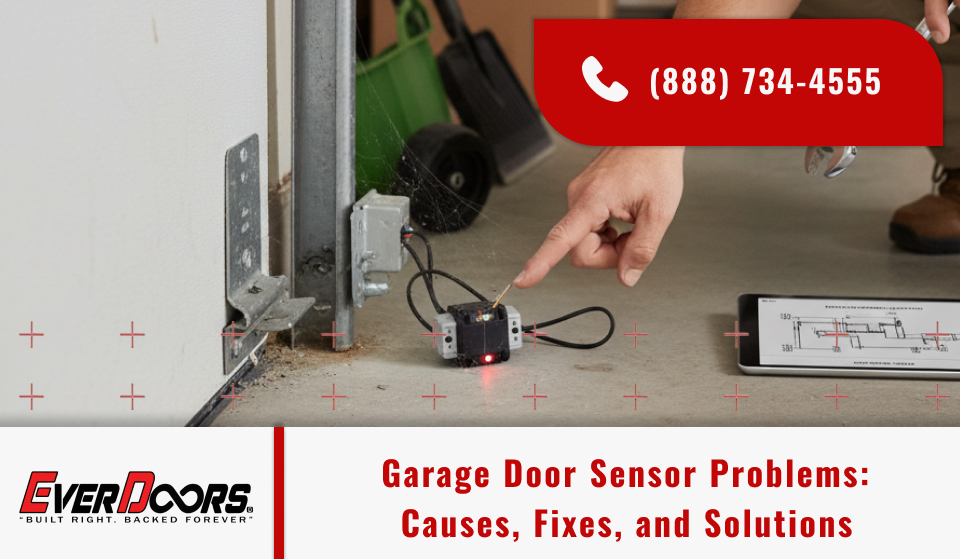
Garage door safety sensors are photoelectric devices mounted on both sides of the door opening near the floor. Specifically, understanding how they work helps you troubleshoot garage door sensor problems and garage door sensor not working accurately.
Here is how the sensor system operates:
- One sensor transmits an invisible infrared beam across the door opening
- The other sensor receives the beam and confirms the path is clear
- When the beam is unbroken the opener allows the door to close normally
- When something breaks the beam the opener immediately reverses the door
- The sending sensor typically shows a steady amber or green light
- The receiving sensor shows a steady green light when properly aligned
- Federal law has required safety sensors on all residential openers since 1993
Because these sensors protect people and pets from being struck by a closing door, they must function correctly at all times. Therefore, a garage door sensor not working is both an inconvenience and a safety concern that requires prompt attention.
Common Signs of Problems
Garage door sensor issues produce specific symptoms that help you identify the problem quickly. Furthermore, recognizing these signs prevents you from misdiagnosing the issue as an opener failure.
Here are the most common signs of garage door sensor problems:
- The door starts to close then immediately reverses back up
- Also, the opener lights flash a specific number of times indicating a sensor error
- Furthermore, the door closes only when you hold the wall button continuously
- One or both sensor lights are off, blinking, or showing a different color than normal
- Additionally, the door closes sometimes but not consistently
- The remote and wall button open the door normally but closing fails every time
- Finally, the door reverses even when nothing is visibly blocking the sensors
A garage door sensor malfunction often mimics opener problems because the door appears to work in one direction but not the other. Consequently, always check the sensors first when your door opens but refuses to close.
Common Causes of Garage Door Sensor Problems
Several factors cause garage door sensor issues to develop. Specifically, understanding these causes helps you fix the problem faster.
Misaligned sensors Vibration from daily door operation gradually shifts sensor positions until the beam no longer connects. Furthermore, bumping a sensor with a foot, bicycle, or stored item knocks it out of alignment instantly. In addition, garage door sensor alignment is the fix for most sensor complaints.
Dirty sensor lens Dust, cobwebs, dirt, and moisture on the sensor lens block or weaken the infrared beam. Consequently, the receiving sensor cannot detect the beam and triggers a reversal. Furthermore, garage environments expose sensors to more debris than most homeowners realize.
Sunlight interference Direct sunlight hitting the receiving sensor overwhelms the infrared beam and causes false triggers. As a result, the door may work perfectly in the morning but refuse to close during afternoon hours when sun angles change.
Damaged wiring Rodents chewing through sensor wires, staples piercing insulation, and age-related wire deterioration break the electrical connection. Furthermore, damaged wiring causes intermittent failures that are difficult to diagnose without inspection.
Failed sensor hardware The sensor circuit board, LED transmitter, or photoelectric receiver can fail from age, moisture exposure, or power surges. Consequently, a sensor that produces no light at all despite having power has likely failed internally and needs garage door sensor replacement.
How to Fix Garage Door Sensor Alignment
Garage door sensor alignment resolves the majority of sensor problems. Furthermore, knowing how to align garage door sensors takes less than five minutes with no special tools.
Step 1: Check the sensor lights First, examine both sensors to identify which one has an abnormal light. Specifically, the sending sensor should show steady amber or green while the receiving sensor shows steady green when aligned.
Step 2: Clean both lenses Next, wipe both sensor lenses with a soft dry cloth to remove dust and debris. Consequently, cleaning alone fixes many sensor problems without any adjustment.
Step 3: Check for obstructions Then, verify nothing is blocking the beam path between the two sensors. Furthermore, remove any items stored near the sensors that could partially block the beam.
Step 4: Loosen and adjust the receiving sensor If cleaning does not fix the problem, loosen the wing nut or bracket screw on the receiving sensor. Furthermore, gently tilt the sensor until the green light turns steady. In addition, the light changes from blinking to solid when proper alignment is achieved.
Step 5: Tighten and test Finally, tighten the bracket to lock the sensor in position and test the door through several complete close cycles. Furthermore, wave a broom handle through the beam to verify the safety reversal activates properly.
If garage door sensor alignment does not restore normal operation, the problem is likely wiring or sensor hardware failure.
When Garage Door Sensor Replacement Is Necessary
Sometimes garage door sensor problems cannot be solved with cleaning or alignment. Therefore, garage door sensor replacement is necessary when the hardware has failed.
Here are signs you need to replace garage door sensors:
- No light appears on either sensor despite power reaching the unit
- Also, the receiving sensor light blinks continuously regardless of alignment position
- Furthermore, wiring is visibly damaged, frayed, or chewed through
- The sensor housing is cracked and moisture has reached internal components
- Additionally, sensors are more than 15 years old and fail repeatedly after alignment
Knowing when to replace garage door sensors saves you from repeated alignment attempts on failed hardware. Furthermore, replacement sensor pairs cost between 30 and 60 dollars for most opener brands. In addition, professional installation including wiring and alignment typically costs between 100 and 200 dollars total.
When to Call a Professional for Garage Door Sensor Problems Near You
Some sensor problems require professional diagnosis and repair. Therefore, contact a technician for garage door sensor problems near you if any of the following apply:
- The door refuses to close despite cleaning and realigning the sensors
- Sensor wiring appears damaged or you suspect rodent damage
- Both sensors show no lights despite the opener having power
- The opener flashes error codes that indicate a wiring fault
- You need sensors replaced and properly wired to an older opener model
- The door closes when holding the wall button but not from the remote
A garage door sensor problems expert near you tests sensor alignment, signal strength, wiring continuity, and opener board communication to find the exact failure. Specifically, they carry replacement sensors for all major brands and complete the installation on site. In addition, they verify the safety reversal system functions correctly before leaving.
Do not bypass your safety sensors or tape them together as a temporary fix. Furthermore, disabled sensors remove the safety protection that prevents the door from closing on people, pets, and objects. In addition, bypassing sensors may violate local building codes and void your opener warranty. Instead, call today to schedule your sensor diagnosis and restore safe automatic operation to your garage door.
Phone: (888) 734-4555
Email: info@everdoors.com
Website: https://www.everdoors.com/